Shopping malls — an architect’s reflections
Today’s topic isn’t quite obvious — a bit personal, but with one foot in the professional, … as is often the case with me.
From real life
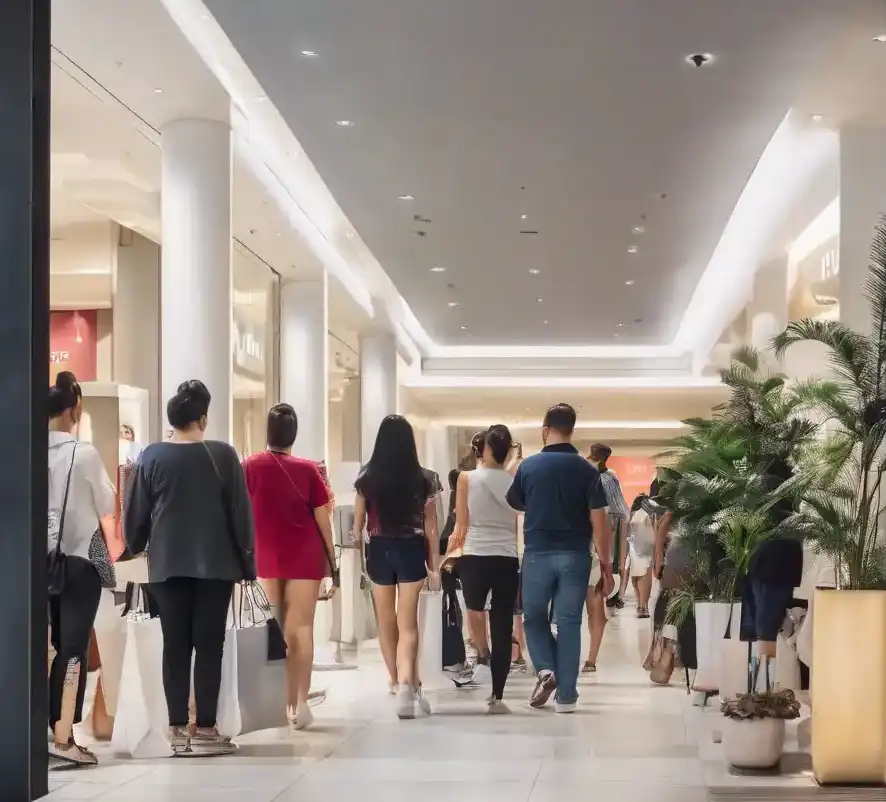
I was recently in a shopping mall, refreshing my teen daughter’s wardrobe — kids grow, after all. I’ll be honest: I’m not a fan of shopping, of wandering through stores and malls. I only go when there’s a real need and the visit can’t be put off any longer. So when I do go, shopping is frustrating — it always adds up to a sizeable bill, plus there’s heavy fatigue from walking, searching, waiting, the noise, the lighting, and so on.
Waiting — that’s actually the main reason I’m writing this. Once my teenage daughter had finally picked her try-on set — arms loaded with hangers, sizing all over the place — we found the changing rooms and joined the queue. It was an afternoon, or maybe a Saturday, so the mall was packed. The queue was hardly small, but I figured: I’d promised these clothes for ages, we were already there, we wouldn’t leave empty-handed.
We were maybe fifth in line, in a tight passage right under a row of bright, hot lights, in a corner with practically no air movement. The line in front of us hardly moved — there were three or four cabins. While we waited (with nothing changing) several more people queued behind us. Hangers full of clothes were heavy; the longer we stood, the heavier they got. We must have stood there 30–40 minutes for the chance to try on a few items and finally pick 2–3 to buy. Honestly — if it had been just for me, I’d have dropped it all and walked away. I wonder how many customers give up exactly because of badly organised changing rooms. When our turn came, the cabin was small, stuffy and even slightly smelly — it was hot in the store.
What I’m getting at
I’m getting at this — dear store designers, owners, managers …
It’s somewhat surprising. You design stores packed with displays where every model hangs on dozens of hangers — a real visual abundance. You give us, the customers, plenty of choice (often too much). Then we pick a handful of pieces to try on … and we get this absurdly small fitting area where everyone bottlenecks.
It’s clear that during peak hours the trying-on zone is the constraint of the entire store. Imagine: I’m a willing customer, holding pieces I picked, ready to spend money — but the system makes me wait so long, in such uncomfortable conditions, that I genuinely consider walking away. That’s a brutal user-experience problem. From an interior designer’s standpoint: in any space where the goal is sale or service, the bottleneck zones must scale to peak load, not idle hours. Comfort there isn’t a luxury — it’s the hinge of conversion.
What does this have to do with renovation
That’s the link. We tend to design our homes the same way: more eye-pleasing focal points, more “wow” zones — and not enough thought given to flow, transitions, the “third place” between rooms. Then in everyday use we get tired, irritated, lose space, and stop loving our own home. Just like in a mall, where we want to leave with empty hands.
So — when designing or renovating: think about flow zones, waiting zones, transition zones. Make them comfortable, well-lit, ventilated, with somewhere to set down a bag, take off a jacket, sit for a moment. Don’t only focus on the “showcase” of the salon. Daily life happens at the edges.